Building a trusted and credible brand is a fundamental foundation of sustainable business operations, particularly in the financial services sector, which is intrinsically linked to consumers’ quality of life and financial security. The Company recognizes that customer trust is derived from accurate, transparent, and responsible communication, together with the consistent delivery of superior experiences that continuously respond to customer needs.
The Company places strong emphasis on responsible advertising by ensuring that information related to financial products and services is complete, clear, and not misleading, to support customers in making careful and fair decisions. In this regard, the Company strictly adheres to ethical principles and regulatory requirements, including Market Conduct principles, in the conduct of its marketing activities.
At the same time, the Company is committed to enhancing customer satisfaction through the continuous development and improvement of products and services, guided by a customer-centric approach. Customer feedback and suggestions are actively gathered and incorporated to continuously improve products and services quality. These efforts contribute to strengthening long-term customer relationships and reflect the Company’s commitment to being a trusted brand that customers choose and continue to choose.
Positive Impacts: A trusted and reputable brand strengthens long‑term customer relationships, leading to continued service usage and stable business growth. Such trust also helps reduce marketing and complaint management costs and supports the Company’s overall financial stability.
Negative Impacts: If the Company’s trustworthy brand image does not align with actual operations, it may create unrealistic customer expectations and increase reputational risk. In the event of errors or customer complaints, the impact on trust can be severe and may result in additional costs related to problem resolution and customer remediation.
Positive Impacts: A trusted brand can play a role in promoting responsible environmental behavior through responsible communication and the encouragement of digital service adoption, which helps reduce resource consumption and paper usage. Brand credibility also supports greater acceptance of the Company’s environmental practices.
Negative Impacts: Environmental communication that is not carefully managed or not aligned with actual operations may give rise to risks of overstated claims or perceptions of greenwashing. Such risks may adversely affect stakeholder confidence over the long term.
Positive Impacts: A trusted brand helps enhance customer satisfaction and positive customer experiences, contributing to stronger engagement and brand loyalty. Responsible communication and transparency also help consumers in making decisions, reduce risks associated with inappropriate use of financial services, and promote the overall well-being.
Negative Impacts: If a brand has a strong influence on consumer decision-making, it may pose risks of undue persuasion, particularly among vulnerable groups. In the absence of effective responsible advertising governance, such influence may lead to excessive indebtedness or unfairness for certain groups.
Positive Impacts: A trusted and credible brand reflects respect for consumer rights, including the right to accurate information, the right to privacy, and the protection of personal data. Brand credibility also supports fair and equitable treatment of stakeholders.
Negative Impacts: In cases where customer data management or marketing communications lack due care, this may lead to risks of privacy violations or unintentional discrimination, which could adversely affect vulnerable groups and undermine brand trust.
The Company recognizes the importance of transparent, accurate, and fair communication and marketing practices in building customer trust and confidence, while reducing the risk of miscommunication that may lead to misunderstanding or inappropriate decision-making regarding financial products and services. Accordingly, the Company has established Responsible Advertising and Marketing guidelines covering personal loan products, credit cards, and all types of financial services, including the following:
The Company places emphasis on fair and transparent service standards that are aligned with the principles of Responsible Lending. Accordingly, all employees, including both relevant customer-facing employees and customer-non-facing employees, are mandatorily required to attend annual training on Market Conduct & Responsible Lending. All participants are required to pass the assessment with a 100% completion rate to ensure that employees at all levels possess the fundamental knowledge necessary to perform their duties correctly and in accordance with the standards.
In addition, employees who work directly with customers, such as sales agents, KTC TOUCH service point staff, and Contact Center officers, receive additional role-specific training to further enhance service standards. This training strengthens communication skills as well as responsible advertising and marketing practices, helps prevent unfair sales practices, and reduces the risk of consumer misunderstanding. Furthermore, the Company regularly monitors and evaluates compliance with established guidelines through knowledge assessments and internal audits to ensure that service and communication related to consumer lending products comply with applicable laws, policies, and regulations.
The Company organized the Card Acquisition training program to enhance the knowledge and develop the capabilities of Contact Center employees. The training content covered knowledge of KTC products, applicant qualifications and required supporting documents, application assessment criteria, as well as Market Conduct and Responsible Lending principles. In addition, the program included product and service sales processes, sales conversation standards, knowledge of operational systems, and compliance with fundamental consumer rights. Emphasis was placed on promoting fair and equitable access to financial services to ensure that customers receive transparent services, free from deception, coercion, harassment, or any form of exploitation, thereby protecting customer interests and strengthening trust. This program enables Contact Center employee to provide financial information accurately, transparently, and fairly, in alignment with the Company’s operational standards for enhancing service quality in an ethical and responsible manner.
A total of 209 persons participated in the program
The Company placed importance on developing the capabilities of its employees and sales agents’ network, who play a key role in responsibly connecting financial products with consumers. In 2025, the Company organized an annual seminar under the theme “BREAKING YOUR BOUNDARIES: Moving Beyond Limits Toward Excellence” to enhance sales skills, service standards, and knowledge of fair service practices among sales agents nationwide.
The program focused on building knowledge of Market Conduct, Responsible Lending principles, and fundamental consumer rights, while supporting compliance with the regulations of the Bank of Thailand. This enables sales agents to provide product information accurately, transparently, and appropriately in line with customers’ repayment capabilities, thereby reducing the risk of mis-selling and contributing to higher standards of financial services and strengthened consumer confidence.
More than 300 persons participated in the program
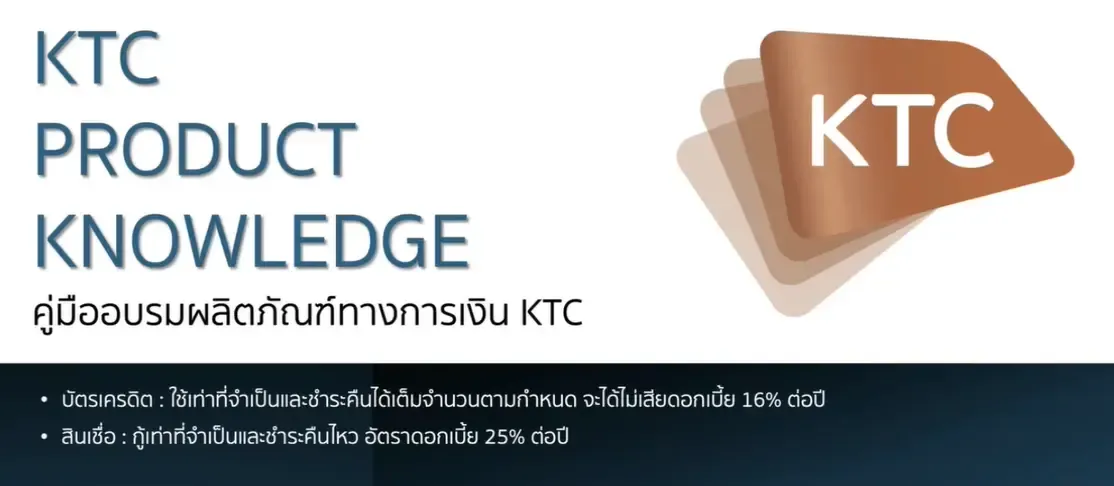
The Company placed importance on providing training for sales agents through the Product Knowledge Credit Card & KTC PROUD program. This program aims to equip participants with accurate knowledge of KTC’s products, while promoting responsible financial behavior and enhancing awareness of individuals’ financial capacity. The knowledge gained enables participants to further develop their capabilities, build sustainable careers, and generate stable income as sales agents of KTC.
A total of 1,017 persons participated in the program
The Company placed importance on the continuous development of sales agents by implementing programs designed to inspire and enhance knowledge, enabling participants to define their own paths to success. The program focuses on strengthening knowledge and skills in accurately presenting KTC products, while providing opportunities to exchange sales insights and best practices among participants. It also emphasizes awareness of roles and responsibilities under Market Conduct principles and encourages participants to cascade the knowledge gained to their teams to drive team performance.
In addition, the Company organized activities to announce results and to recognize high-performing participants, along with offering online training courses designed to empower and foster a positive mindset, including:
A total of 195 persons participated in the program
The Company is committed to providing inclusive services that cater to the needs of all customer groups, including disabled or elderly customers, ensuring convenient, safe, and equitable access to its products and services. To support this commitment, the Company strategically locates its KTC TOUCH service points within department store equipped with accessibility features, such as wheelchair ramps, elevators, spacious walkways to accommodate wheelchair users, and service counters designed for convenient access.
These accessibility features help reduce barriers for customers with mobility limitations, enabling disabled or elderly customers to access the services conveniently and safely while enjoying an inclusive and positive service experience. This initiative reinforces the Company's commitment to promoting equal access to its services for all customer groups.
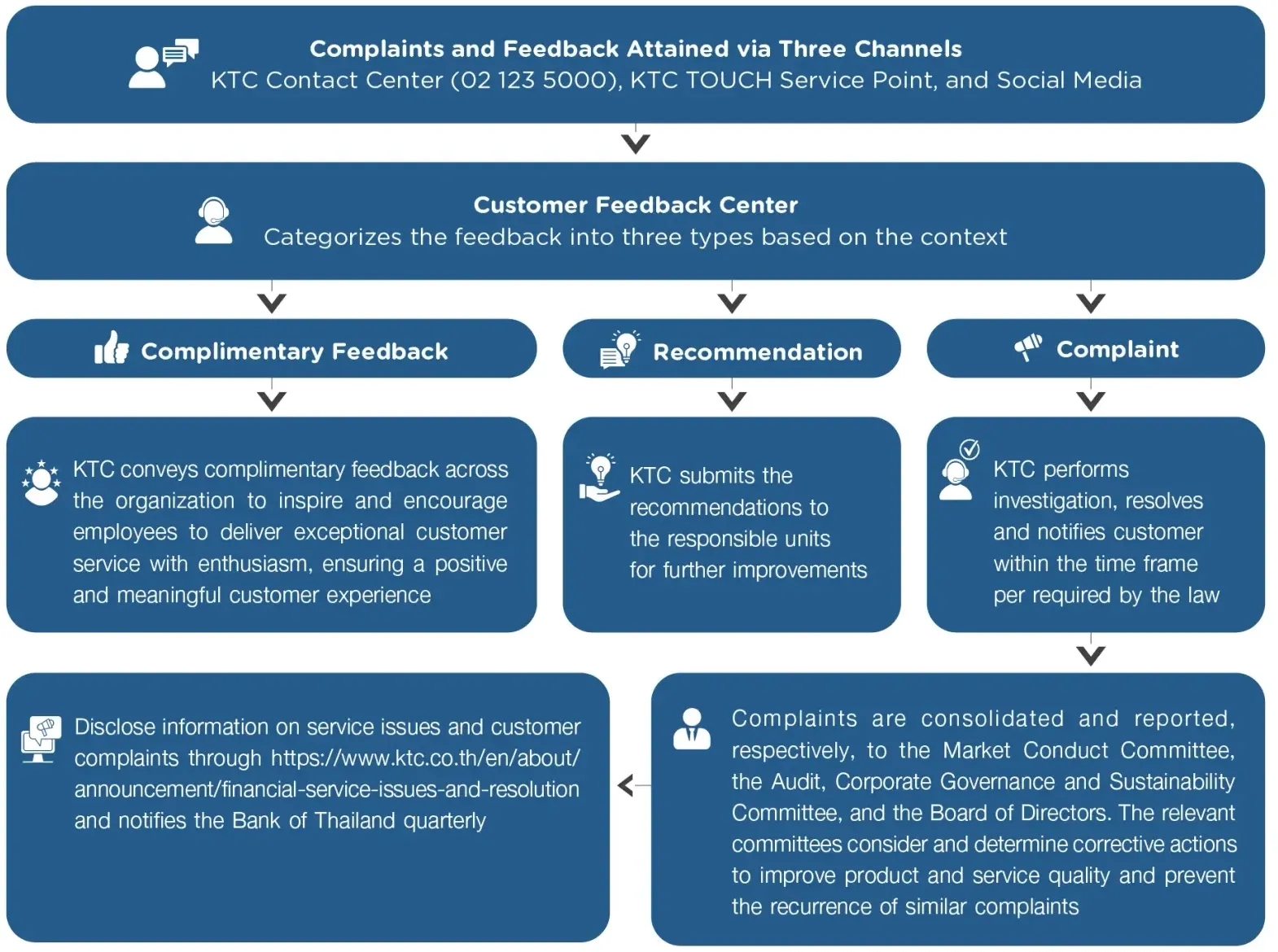
The Company places importance on customer feedback across all dimensions through a clear and transparent process to manage customer feedback, enabling a comprehensive reflection on customer satisfaction, expectations, and experiences. The Company has established a centralized service for receiving complaints, compliments, and recommendations through multiple channels, including service points, telephone, and social media, to collect, classify, and analyze customer feedback. The information obtained is used to assess the impacts of products and services and serves as insights for improving operational processes, developing new products, and continuously enhancing service quality in line with customer needs and expectations. In addition, the Company systematically monitors the status and outcomes of complaint resolution and applies disciplinary measures or warnings to sales agents in accordance with the Company’s policies and guidelines, to ensure that customers receive appropriate, timely, and fair services.
The Company enhances the effectiveness of managing customer feedback and complaints by establishing quality and turnaround-time targets for complaint resolution within 7 days, serving as operational standards for relevant business units. The Company also regularly monitors, measures, and reports performance results to management and relevant committees. These efforts reflect the Company’s responsibility in protecting consumers and help strengthen stakeholder confidence that customer complaints are addressed and resolved appropriately and in a timely manner.
For additional information on the disclosure of complaints and the resolution of issues related to financial services, please refer to https://www.ktc.co.th/en/about/announcement/financial-service-issues-and-resolution
The Company places strong emphasis on enhancing customer satisfaction and trust across all stages of service and is committed to continuously improving customer experience to ensure that all customer segments receive transparent, fair, and truly responsive to their need’s services. The Company conducts annual customer satisfaction assessments to gather feedback and evaluate satisfaction with its products and services across various dimensions, including ease of access to services, quality of advisory services, responsiveness to complaints, delivery timeliness of service, and overall trust in the organization.
The assessment results are analyzed to identify strengths and areas for improvement and are used to develop concrete improvement plans within relevant business units.
The Company places importance on conducting customer satisfaction assessments in a systematic and continuous manner as a key indicator for enhancing service quality and improving the overall customer experience. The assessment results are used to identify priority areas for service improvement and to support workforce development and training plans in alignment with the Company’s measures, including Market Conduct guidelines.
In this regard, the Company gathers customer feedback through all communication channels, including KTC Contact Center, KTC TOUCH service points, the Company’s website, and various social media platforms. At the same time, the Company regularly conducts customer satisfaction surveys covering all service channels. The insights obtained are analyzed and utilized to improve products, operational processes, and enhance the overall customer experiences across the Company’s products and services.
The Company conducts an annual customer satisfaction survey among its credit cardholders using the Net Promoter Score (NPS), an index that reflects customers’ willingness to recommend KTC credit cards to others. The survey results are systematically analyzed and utilized to enhance and develop the Company’s credit card products and services. This process forms an integral part of the Company’s annual development plan.
Survey results over the past several years have demonstrated a positive trend in customer satisfaction. This improvement aligns with the enhancement of credit card benefits tailored to members’ spending behaviors, the continued development of the KTC FOREVER rewards program, and the elevation of user experience through the KTC Mobile application. These factors have collectively supported sustained and continued usage of the Company’s products and services.
The Company conducts customer satisfaction surveys for KTC TOUCH service, using the Net Promoter Score (NPS) as the primary performance indicator. The survey results are reported to management on a monthly basis and serve as a governance mechanism to monitor and maintain service quality standards on an ongoing basis. If the satisfaction score falls below the established benchmark, the Company takes proactive measures to review customer feedback, identify the root causes of the issues, and implement appropriate, systematic improvements.
The KTC TOUCH service satisfaction survey results reflect the Company’s continuous efforts to enhance customer experience. These improvements have been driven by the development of employees’ communication skills, problem-solving capabilities, and proactive service approach, resulting in higher service standards and greater professionalism. The Company has streamlined and optimized its service processes to reduce waiting times and improve operational efficiency. At the same time, it has improved the branch environment to ensure cleanliness, comfort, and a clearly organized queue management system, reinforcing orderliness and attention to detail. In addition, the Company places strong emphasis on customer feedback. All comments and suggestions are systematically analyzed and used to refine service processes, with progress and outcomes regularly communicated to relevant departments. This approach strengthens stakeholder confidence in the organization’s commitment to continuous improvement.
The Company conducts customer satisfaction surveys after every interaction through its Contact Center channel, applying clearly defined evaluation criteria to continuously monitor service quality. In case the satisfaction score falls below the established benchmark, the company analyzes the root causes of the issues and implements systematic corrective actions, along with preventive measures to avoid recurrence. Additionally, an annual internal service quality assessment is conducted to support the ongoing improvement of service processes and standards.
In addition, workforce planning is set in alignment with workload during different periods to ensure operational efficiency. The Company also provides continuous training on product knowledge and service standards to enhance the employees’ expertise in service delivery. A positive working environment is promoted to ensure employees feel happy, motivated, and able to deliver care and satisfaction to customers, resulting in improved overall customer experience.
Key factors contributing to the continual improvement of service quality scores include the systematic enhancement of team capabilities through comprehensive training and in‑depth coaching. These programs cover product knowledge, communication skills, handling complex cases, and regular performance reviews. As a result, employees are more confident, precise, and empathetic in their service interactions. At the same time, ongoing development of the Knowledge Base serves as a centralized, fast-searchable, and continuously updated information source, reducing inconsistencies in responses and improving accuracy and standardization in problem resolution. Furthermore, quality control processes including monitoring, clear assessment criteria, calibration sessions, and closing feedback loops with structured action plans and coaching, strengthen service consistency and meaningfully elevate service quality.
The Company conducts monthly customer satisfaction surveys on a regular basis to assess the performance of outsource sales agents responsible for presenting KTC’s products accurately, comprehensively, and transparently. This includes providing clear information on benefits, fees, and interest rates in accordance with the sales manual and the Company’s Market Conduct Policy. The survey also evaluates overall service quality, professional attire, and service etiquette to ensure a comprehensive assessment of operational standards. When customer feedback is received, the Company informs the relevant functions to analyze the evaluation results and determine appropriate improvement measures. These actions may include enhancing service quality, refining product presentation, developing training programs, strengthening coaching techniques, and continuously updating product information to ensure accuracy and relevance.