For additional information, please refer to Form 56-1 One Report 2025 under “Meeting attendance of the board of directors” topic
The Company believes that good corporate governance forms the foundation of sustainable growth and serves as a key mechanism for effectively driving the organization toward its strategic objectives, while upholding responsibilities toward society and the environment. Accordingly, the Company is committed to strengthening a transparent, fair, and accountable governance structure, alongside fostering an ethical corporate culture. This ensures that business operations across the entire value chain - from upstream to downstream - including customer service, personal data management, risk management, and responsible lending, are conducted in compliance with applicable laws and international standards, while meeting stakeholder expectations in all dimensions.
The Company received a score of 100 in the Corporate Governance Report (CGR) by the Thai Institute of Directors (Thai IOD)
The Company received a score of 110 in the Corporate Governance Report (CGR) by the Thai Institute of Directors (Thai IOD)
Positive Impacts: Good corporate governance enhances stakeholder confidence, enabling the Company to achieve effective growth, exercise prudent risk management, and foster a business ecosystem that supports investment and sustainable development.
Negative Impacts: Stringent corporate governance requirements may result in slower decision-making processes and increased internal controls.
Positive Impacts: Integrating environmental considerations into corporate governance enables the Company to establish appropriate approaches for identifying and managing environmental risks, while creating opportunities to reduce operational costs and support the transition toward business operations that account for long-term environmental impacts.
Negative Impacts: Compliance with environmental regulations and standards may result in additional procedures and increased operational costs.
Positive Impacts: Good corporate governance promotes fairness in the development of products and services and strengthens the Company’s role as a responsible member of society through transparent operations and accountability to stakeholders. This enhances public trust and confidence in the Company.
Negative Impacts: In the absence of strong corporate governance, there may be risks of stakeholder rights violations, non-transparent communication, or decision-making that fails to adequately consider social impacts, which could adversely affect the Company’s reputation and its long-term relationship with society.
Positive Impacts: Corporate governance aligned with international human rights principles enables the Company to establish policies and processes that respect human dignity, promote non-discrimination, and prevent both direct and indirect human rights violations across the value chain.
Negative Impacts: In the absence of a systematic approach to human rights governance, there may be risks of rights violations affecting employees, customers, or business partners, potentially leading to legal exposure, reputational damage, and adverse impacts on the Company’s long-term sustainability.
The Company conducts its business in accordance with the good corporate governance principles, in line with the guidelines prescribed by regulatory authorities such as the Stock Exchange of Thailand and the Securities and Exchange Commission (SEC). The Company is committed to operating with transparency, fairness, accountability, and reliability to build confidence among all stakeholder groups and to promote long-term sustainable growth. To ensure consistent implementation across the organization, the Company has established a Corporate Governance Policy to serve as a guiding framework for the Board of Directors, management, and employees at all levels in performing their duties with integrity, in compliance with applicable laws, ethical conduct, and social responsibility. The Board of Directors regularly reviews Corporate Governance Policy annually to ensure its alignment with applicable laws and regulations, as well as with evolving business contexts.
For additional information on Corporate Governance Policy, please refer to the Company’s website https://www.ktc.co.th/pub/media/sustainability-development/CG/document/KTCEN2025-CG-Policy.pdf
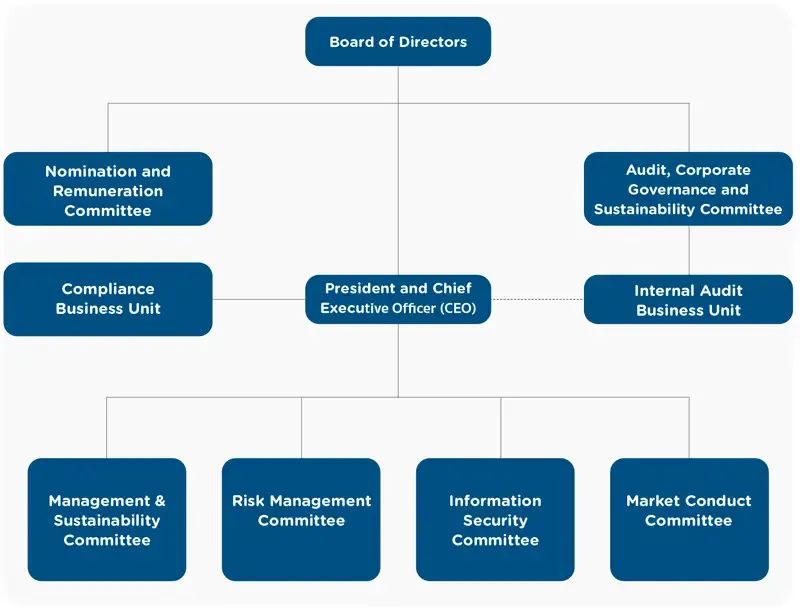
The Board of Directors plays a critical role in overseeing the Company’s operations and the management of its resources in a responsible manner, in compliance with applicable laws and relevant regulations. The Board is responsible for setting the Company’s policies, strategies, vision, mission, and business plans to ensure that operations are effective, transparent, and aligned with the Company’s risk management framework. In addition, the Board regularly oversees internal controls and risk management processes to provide assurance to shareholders and all stakeholder groups. The Company’s corporate governance structure adopts a One-Tier System, comprising the Board of Directors and two sub-committees, namely the Nomination and Remuneration Committee and the Audit, Corporate Governance and Sustainability Committee.
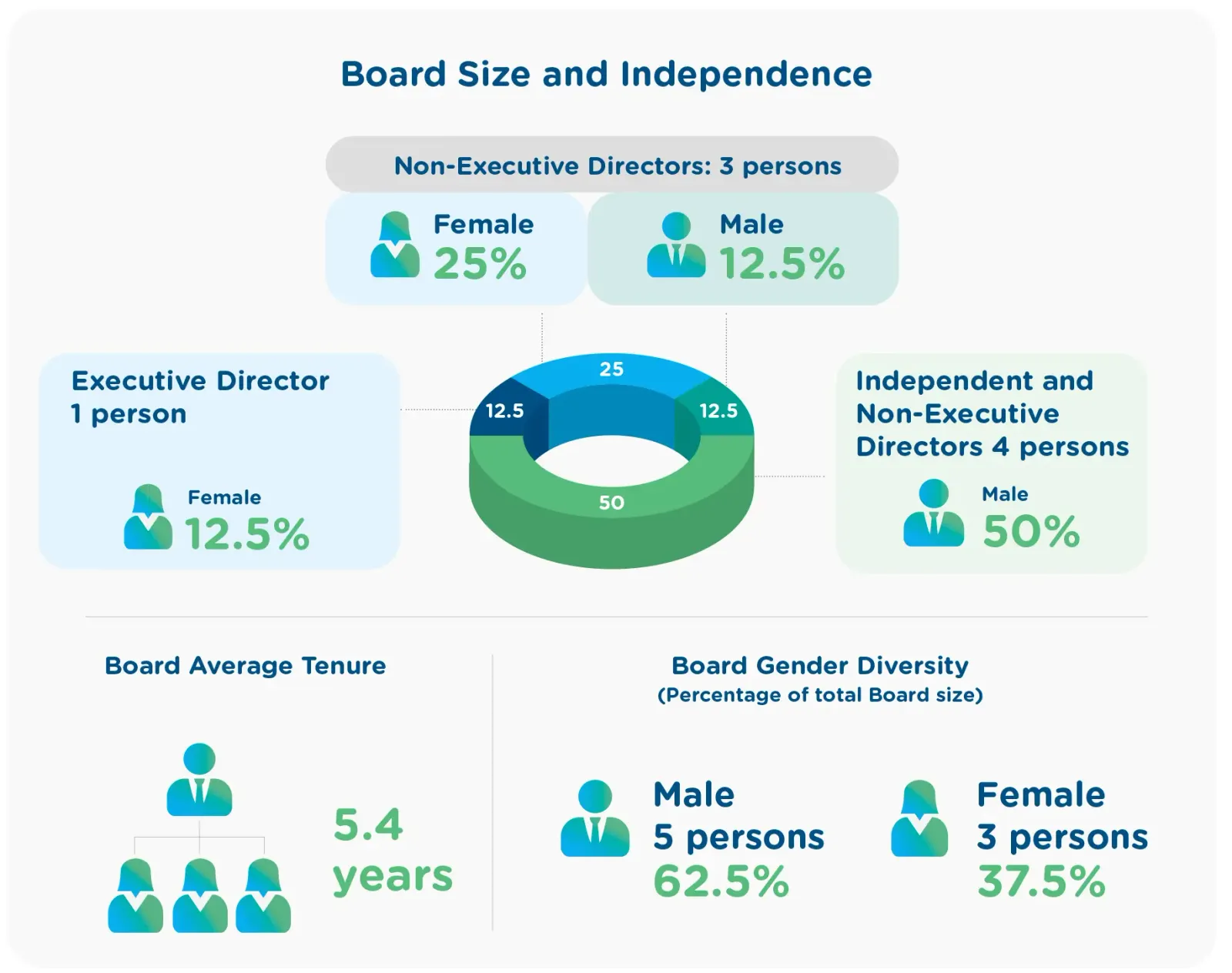
The Board of Directors comprises a total of eight directors. The Company has stipulated that independent directors shall account for at least one-third of the total number of directors and no less than three persons. At present, the Chairperson of the Board is a non-executive and independent director and is not the same person as the Chief Executive Officer. For the appointment of directors, the Company nominates individual directors whose terms have expired for consideration and approval at the Annual General Meeting of Shareholders, in accordance with the criteria and guidelines set out in the Corporate Governance Policy.
Additionally, the Company is committed to promoting gender diversity at the board level, with the Board of Directors in 2025 reflecting a 5:3 ratio of male to female directors.
Board member are elected annual basis: In 2025, as reported in the Minutes of the 2025 Annual General Meeting of Shareholders, the directors due to retire by rotation were Mr. Praphaisith Tankeyura, Mr. Natapong Vanarat, and Ms. Kornkanok Fuengfung. The meeting considered the matter and resolved to propose to the shareholders’ meeting the reappointment of the directors retiring by rotation to serve for another term.
In addition, following good corporate governance, terms of office of independent directors are limited to no more than 9 years. In 2025, the average term of office of directors was 5.4 years.
The Company has established guidelines regarding the holding of directorships in other companies by Board of Directors, Chief Executive Officer, and employees. To ensure effective performance of duties in accordance with the good corporate governance principles.
For additional information, please refer to Form 56-1 One Report 2025 under “Selection, development and evaluation of duty performance of the board of directors” topic
In the nomination process, the nominee must uphold appropriate qualifications requirements and not possess forbidden characteristics per the guidelines of the Stock Exchange of Thailand, the Securities and Exchange Commission, or other relevant regulatory authorities. The nomination process is conducted in a transparent manner, and the nominee are required to have the suitable qualifications, skills, knowledge, capabilities, and experience as defined by the Company regardless of sex, gender, race, nationality, or religion, where proportion, number, diversity, and composition are considered appropriate in each division.
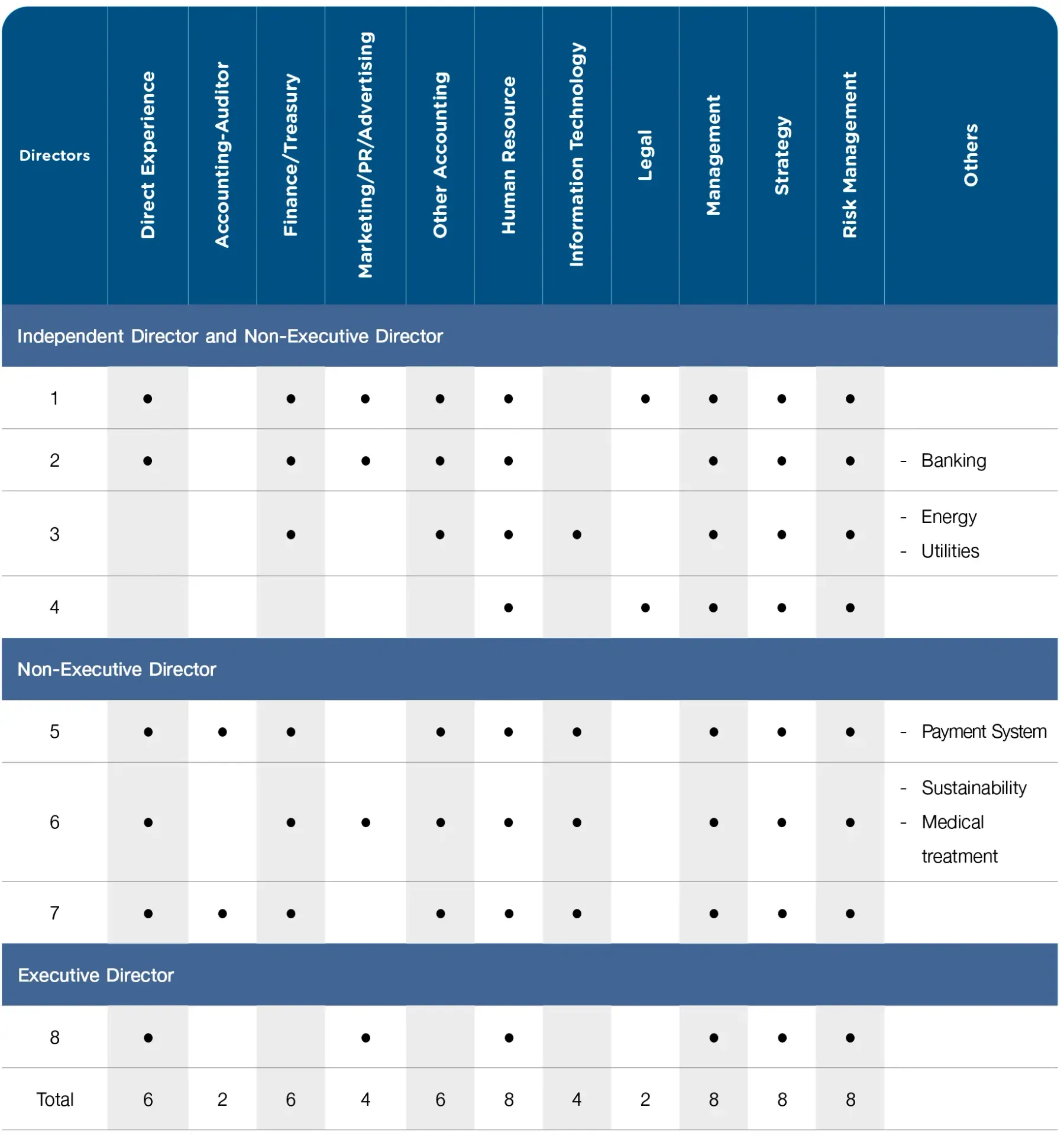
Accordingly, the Company has developed a Board Skills Matrix covering knowledge, skills, expertise, and experience, which is used as a tool to assess the qualifications of existing directors and as a guideline for future director nominations. The objective is to promote good corporate governance and support the achievement of the Company’s strategic objectives.
The Company organizes regular meetings of the Board of Directors to consider key matters related to business operations, including the approval of financial statements, performance monitoring, risk management, corporate governance, and sustainability development. Each meeting is supported by a well-structured agenda designed to align with the Company’s strategic objectives. Board members consistently attend meetings and actively contribute their views and opinions, ensuring that the Board’s decisions are made with due diligence and in the best interests of the Company.
In addition, the Company conducts an annual performance evaluation of the Board of Directors, based on clearly defined and comprehensive assessment criteria to reflect the effectiveness and appropriateness of corporate governance practices. The evaluation comprises four formats: (1) Self-Assessment for the Board of Directors as a whole, (2) Self-Assessment of Individual Directors (Self-Assessment), (3) Self-Assessment of Individual Directors (Cross-evaluation), and (4) Self-Assessment for Committees as a Whole. The evaluation results are used as a basis for continuous improvement and enhancement of the effectiveness of corporate governance.
In 2025, the Company held a total of 15 meetings of the Board of Directors, with an average board meeting attendance of 98.3%.
The Company requires minimum board attendance of at least 75% of all board meetings.
Board of Directors’ Performance Evaluation Results for 2025
With integrity and prudence, the Company’s Board of Directors is obliged to promote the best interest of shareholders, especially in terms of approving the Company’s vision, mission, strategies, and significant matters concerning the Company’s business directions and policies as well as its business plans and annual budget – based on logical reasoning, comprehensive business environment and social analysis, and social responsibility. At the end of the second quarter of each year, the Company’s Board of Directors shall convene a meeting to review the policies and goals. In the last quarter, they shall set up a business plan for the upcoming year in order that it can be forwarded to the management for a brainstorming session with members of the management team from various functions, to set effective business strategies to achieve common goals.
Additionally, the Company’s Board of Directors is responsible for ensuring that the performance of the management team is fully aligned with the Company’s goals by using key specified performance indicators (KPIs). The performance shall be evaluated from the beginning of the year, on a monthly and quarterly basis, in order that the operational status can be monitored at all stages. If the performance has fallen below the target, the Board is responsible for identifying causes and finding solutions to problems. At the end of the year, the Board shall evaluate the performance of the management team in comparison with the KPIs defined in the Company’s Performance Agreement (PA). The Company determines those KPIs based on a performance measurement of the Balance Scorecard model which considers four perspectives of business as follows.
Moreover, the Board has responsibility to control and monitor the performance of the management team to ensure transparency, proper corporate governance, and risk management.
The Company evaluates the President & CEO performance once a year from January-December by using Key Performance Indicators (“KPI”), which defines the Company’s business strategies and goals in each year. Corporate KPI is also used to assess all employees including the management capability assessment based on the organization’s Core Value and Core Competency.
The Board of Directors appointed the Nomination and Remuneration Committees to define criteria, consider and evaluate the performance and present evaluation results to the Board of Directors, and approve an appropriate remuneration.
The Board of Directors Meeting No. 1/2026 has considered performance evaluation results and remuneration of the Chief Executive Officer. However, the Chief Executive Officer's performance evaluation results are considered confidential information not to be disclosed.
The Company supports the continuous development of knowledge and skills of the Board of Directors and management through training programs, seminars, and the provision of relevant information related to business operations, laws, and corporate governance to enhance effective decision-making. Orientation programs are provided for newly appointed Board of Directors to ensure an understanding of the Company’s business plans, organizational structure, roles and responsibilities, and key legal matters. Relevant information is also disseminated through electronic systems.
The Company encourages Board of Directors and management to attend training programs relevant to their roles and in accordance with regulatory requirements, to promote continuous learning and strengthen good corporate governance practices. In 2025, the training programs attended included the following:
For additional information, please refer to Form 56-1 One Report 2025 under “Selection, development and evaluation of duty performance of the board of directors” topic
The Company places importance on respecting and protecting the rights of all shareholders on an equitable basis, whether Thai or foreign, without any infringement of shareholder rights. The Company encourages shareholders to fully exercise their legal rights, including the rights to buy, sell, or transfer securities; receive dividends; attend shareholders’ meetings and vote on significant matters; propose agenda items; elect directors; and receive the Company’s information in a transparent manner through accessible communication channels. These practices are intended to enhance shareholder confidence and support sustainable, long-term investment in the Company.
With respect to the holding of the Company’s securities, the Company does not impose any restrictions on the purchase, sale, or holding of its shares by directors, management, or employees. However, such persons are required to comply with the notifications of the Securities and Exchange Commission and the Company’s internal regulations, to ensure that no insider information is used in securities trading and that all transactions are conducted transparently and in accordance with applicable laws.
Regarding government shareholding, Krungthai Bank is currently the Company’s major shareholder. As per the information of the Book-Closing Date (BC) at the end of December 2025, from Thailand Securities Depository Company Limited, Krungthai Bank held 49.29% of the total number of voting rights. The Company did not offer a golden share offering, including did not granting any special rights or privileges to major shareholders or the government.
In addition, the Company grants equal voting rights for each common share(1) under one share, one vote, with no limitation on voting rights. Resolutions are passed by a majority of votes cast, unless stated otherwise in the articles of association or set forth otherwise in the relevant law.
In 2025, the Company’s voting rights were as follows:
Remarks
(1) The Company does not have preferred shares
(2) The Company has not repurchased any shares without voting rights.
(3) Thai NVDR Co., Ltd. is classified as a shareholder without voting rights at shareholders’ meetings as per the information of the Book-Closing Date (BC) at the end of December 2025, from Thailand Securities Depository Company Limited held 6.9% of the Company’s total shares outstanding.
(4) Total voting power is calculated by multiplying the number of voting rights per share by the total number of shares.

The Company has prepared its accounts and financial statements in accordance with the Financial Reporting Standards and Generally Accepted Accounting Principles in the kingdom of Thailand. It adopts the revised and new Financial Reporting Standards including accounting guidance issued by Federation of Accounting Professions which are effective for the accounting periods. The Company regularly discloses financial Information, key financial ratios, and principal accounting policy in financial statements as well as management discussion and analysis (MD&A) on a quarterly.
Krungthai Card Public Company Limited and its subsidiaries (“Company”) formulate the tax policy under the principles of good corporate governance in order to ensure that their business operations can continue to grow in a stable and sustainable manner. With regard to tax practices, the Company adheres to the principles of accuracy, transparency, social responsibility and equitable treatment towards all stakeholder groups. As designated by the Board of Directors, it is incumbent upon the Audit, Environmental, Social Responsibilities, and Corporate Governance Committee to dutifully perform various tasks set out in the Charter of the Audit, Environmental, Social Responsibilities and Governance Committee, and the Committee is thereby responsible for approving the tax policy.