Targets
KTC Mobile users accounted for 89% of all customers in 2025
Performance in 2025
KTC Mobile users accounted for 93% of all customers
The Company recognizes the critical role of rapidly advancing digital technologies in transforming lifestyles and consumer behavior. Convenience, speed, and security in financial transactions are key factors underpinning customer confidence. Accordingly, the Company is committed to the continuous development of digital infrastructure and innovation to enhance the quality, efficiency, and security of its financial products and services, while systematically managing technology and data-related risks. In parallel, the Company continuously adapts to evolving consumer behaviors to strengthen competitiveness, create new business opportunities, and support sustainable, long-term growth.
Digital Innovation is driven by the business functions responsible for identifying, developing, and implementing digital solutions to enhance operational efficiency, improve customer experiences, and create new business opportunities. The scope covers key digital innovation activities, including technology development, digital transformation initiatives, data-driven solutions, process optimization, and the adoption of digital platforms across relevant business areas. These activities support the organization’s ability to adapt to changing business needs while creating value for employees, customers, partners, and other stakeholders.
Positive Impacts: Digital innovation enhances operational efficiency and improves customer experience through the development of digital financial products and services that respond to consumer behaviors. The application of advanced technologies in data analytics and risk management strengthens the accuracy of decision-making, enhances revenue-generation capabilities, and supports long-term competitiveness.
Negative Impacts: Investments in technology and digital innovation require significant capital expenditure and may pose risks to returns on investment if developments do not align with market demand or if technological change occurs rapidly. In addition, reliance on digital infrastructure may elevate business continuity risks in the event of system disruptions.
Positive Impacts: The adoption of digital innovation help reduce resource consumption such as decreased plastic usage through the transition from physical cards to digital cards, reduced paper consumption, and lower travel-related emissions through digital services and processes. These initiatives support the reduction of greenhouse gas emissions from the Company’s operations.
Negative Impacts: The expansion of digital infrastructure and the operation of data centers may lead to increased energy consumption and electronic waste if technology lifecycle management and energy efficiency are not managed effectively.
Positive Impacts: Digital innovation enhances more convenient, faster, and more inclusive service access to financial services, promotes financial inclusion for the public, and supports the strengthening of digital skills among employees and the wider society.
Negative Impacts: The digital divide and unequal access to technology may limit certain groups’ ability to access digital financial services if inclusive service design and appropriate mitigation measures are not adequately implemented.
Positive Impacts: The promotion of respect for human rights through the design of digital innovations that incorporate considerations of privacy, data security, and non-discrimination builds trust and supports the sustainability of financial services.
Negative Impacts: The use of advanced technologies, such as data analytics and automated systems, may pose risks related to privacy infringement or unintended discrimination if ethical governance, transparency, and appropriate oversight are not sufficiently ensured.
The Company places strong emphasis on driving the organization through digital innovation. The Company has established a Generative Artificial Intelligence (Gen AI) Policy to provide a framework for the responsible and appropriate use of AI technologies, while effectively managing associated risks. The Company has also established a clear governance structure has been established, with defined roles and responsibilities assigned to relevant functions to ensure that the development and application of technology are aligned with the Company’s strategic direction and responsive to the evolving digital landscape. This structure encompasses policy setting and strategic direction, solution and infrastructure development, as well as information security management. Such an integrated approach ensures that digital innovation initiatives are effectively implemented, create added value for customers, and sustainably enhance the Company’s competitive advantage.
Promoting the Responsible Use of Generative Artificial Intelligence
The Company recognizes the importance of responsibly adopting Generative Artificial Intelligence (Generative AI) and Artificial Intelligence (AI) technologies in its business operations. The Company aims to promote innovation alongside risk management, data protection, and building trust among stakeholders. Therefore, the Company has established guidelines for AI governance and use within the organization, taking into consideration ethical principles, security, fairness, transparency, and sustainability, covering the following key areas:
Should You Trust AI 100%? Think Before You Prompt & Verify Before You Trust
The company organized a training course designed to promote the ethical and safe adoption of AI in the workplace. The program was intended for employees at all levels who wish to leverage AI to enhance their work efficiency in a responsible manner and in accordance with data ethics principles.
The course covered essential guidelines for using AI safely and responsibly, including best practices for effective prompt writing to achieve accurate and relevant results. Participants also learned the fundamental concepts and proper methodologies for developing AI Agents and integrating them into business processes.
In addition, attendees explored practical use cases demonstrating how AI Agents can be applied to ISO audit and assessment activities to improve data analysis, auditing processes, and report preparation. The training was delivered by experts from the IT Audit Division, who shared their knowledge, experience, and real-world insights on the effective use of AI in audit and compliance functions.
The Company is committed to advancing digital innovation to adapt to the evolving digital landscape under the strategy “Building a Sustainable Future Through Digital Transformation.” The strategy is implemented through four key approaches as follows:
The Company is committed to driving its strategy toward becoming a fully digital organization by leveraging advanced technologies and innovative solutions to develop products and services that deliver experiences aligned with the needs of customers in the digital era. The Company focuses on three core areas: digital products, digital services, and digital channels, while integrating artificial intelligence (AI) and automation to enhance efficiency, reduce costs, and strengthen transaction security. Customers can conveniently access services anytime and anywhere with speed and reliability. At the same time, these initiatives help reduce resource consumption, mitigate data-related risks, and support environmentally friendly operations. Collectively, these efforts aim to achieve strong business growth while advancing the Company toward long-term sustainability.
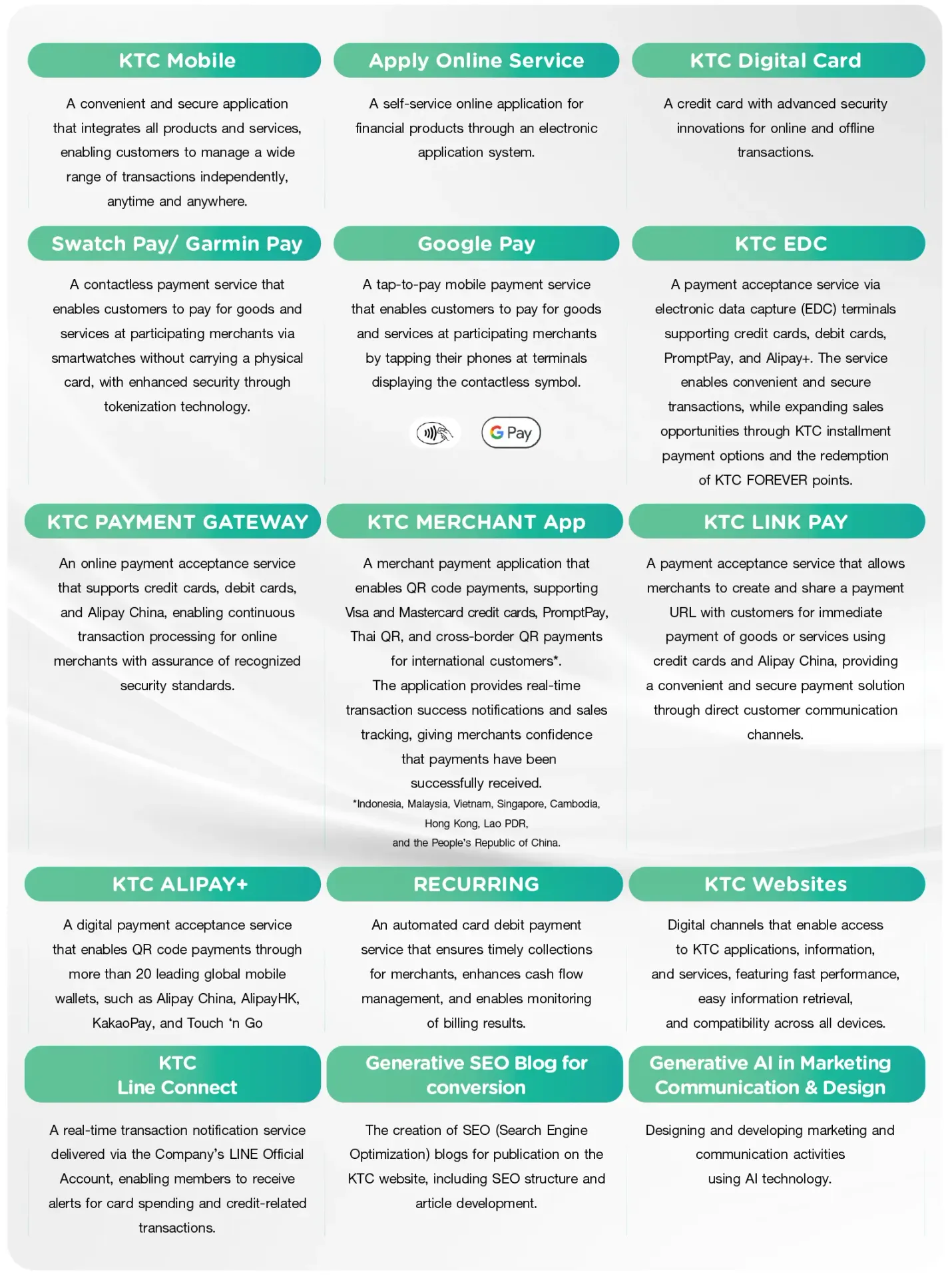
The Company focuses on developing and supporting digital innovations and technologies to deliver efficient products, services, and electronic payment channels that meet customer needs, while providing convenient, fast, and secure access to information and services anytime and anywhere, and enhancing the Company’s competitiveness. In 2025, the Company implemented the following digital innovations.
The Company has continuously enhanced the KTC Mobile application to strengthen digital security standards and deliver efficient user experience. Key security measures include verification of registered phone numbers and devices, application integrity checks, monitoring of suspicious applications, prevention of remote device control, and detection of screen overlay activities, all aimed at mitigating fraud risks and cybersecurity threats. In addition, the Company introduced a feature enabling customers to apply for permanent credit limit increases via the application, allowing faster and more secure access to services. Providing services via the application also enhances inclusive and equitable access to financial services, while reducing paper usage and customer travel. This contributes to lower resource consumption and reduced greenhouse gas emissions.
The number of KTC Mobile users 2,455,375 reached representing 93% of the total customer base, an increase of 8% compared to 2024
The Company offers applications for KTC Credit Card and KTC PROUD Cash Card through an electronic application system (e-Application) to enhance customer convenience by enabling applicants to submit applications, complete forms, upload documents, and verify their identity independently via digital devices anytime and anywhere, with real-time tracking of application status. This approach streamlines application processes and reduces processing time, aligning with evolving consumer preferences for digital channels, while also mitigating fraud risks through electronic identity verification and enhancing the reliability of delivery service. In addition, the fully digital end-to-end application process helps reduce paper usage and the need for travel to submit or collect documents. This contributes to lower resource consumption and reduced greenhouse gas emissions.
A total of 31,121 customers applied through the Apply Online Service channel,
representing an increase from 2024, which was the first year of its implementation
The Company offers the KTC Digital Credit Card to expand its premium customer base, with extensions to Visa Signature and World Rewards Mastercard, under the Digital First concept that emphasizes secure spending through Dynamic CVV (CVC2) technology and numberless cards. These features enable customers to make transactions with confidence across both online and offline channels. Members may opt for a transparent plastic card without a card number or magnetic stripe, reducing risks associated with card theft, data copying, and skimming. In parallel, the Company has developed Apply Online Service via the KTC Mobile application and online platforms to enhance convenience and elevate customer experience. In addition, customers may opt out of receiving a plastic card, which helps reduce resource consumption and greenhouse gas emissions. This initiative supports the Company’s digital financial services strategy alongside its environmental sustainability objectives.
A total of 144,562 customers applied for the KTC Digital Credit Card
The Company has developed the Agent App to support the application process for KTC financial products, enabling authorized agents to record customer information and perform identity verification within the system. This allows customers to receive preliminary application results immediately, enhancing the speed, accuracy, and standardization of service delivery while improving overall customer experience and satisfaction, particularly for customer groups who are less familiar with technology or have limited access to digital devices. Furthermore, digital processing helps reduce paper-based documentation, minimizes the need for branch visits, and lowers energy consumption from travel. These efforts contribute to a reduction in greenhouse gas emissions and are aligned with the Company’s approach to expanding access to financial services alongside sustainable business practices.
A total of 55,111 customers applied for products through the Agent App
The Company has applied Generative AI technologies to Marketing Communication & Design to enhance the quality of communication materials, improve operational efficiency, and strengthen employee capabilities in line with changes in the financial services and digital marketing landscape. The adoption of Generative AI is guided by a human-centric AI approach, whereby AI serves as a tool to support and augment human capabilities rather than replacing. The company utilizes a range of AI tools, including ChatGPT, Gemini, Copilot, Midjourney, Freepik, Adobe, Runway, and KREA, to support creative concept development, design execution, and targeted communication planning.
The use of Generative AI helps reduce repetitive workloads and accelerate the processes of ideation and design development, enabling teams to focus more effectively on strategic work, brand communication, and the creation of customer-centric experiences, which are critical to building trust in financial services. The company emphasizes strong governance in the use of Generative AI by ensuring that all outputs are subject to human review, with due consideration given to information accuracy, intellectual property protection, and the commitment to retrain from using customer personal data, in order to uphold high standards of security, credibility, and stakeholder trust.
In addition, the application of Generative AI enhances resource efficiency by reducing unnecessary revisions and minimizing the production of unused materials, in alignment with responsible and sustainable business practices.
The number of marketing communication design materials increased by 13% compared with 2024