The company is committed to conducting its business with integrity and ethical conduct, recognizing that adherence to business ethics is fundamental to building trust among stakeholders. Accordingly, the Company has established Code of Conduct and implements it through internal communication, employee training, and effective oversight to ensure transparent operations and compliance with the good corporate governance principle. In addition, the Company places strong emphasis on the prevention of corruption and bribery by implementing Anti-Corruption initiatives and fostering an organizational culture grounded in integrity and accountability. These efforts not only help mitigate legal and reputational risks but also form an integral part of the Company’s sustainability strategy, aimed at creating long-term value for society and all stakeholders.
Positive Impacts: Strong business ethics enhance the confidence of shareholders, investors, and business partners, supporting financial stability and sustainable long-term growth. In addition, adherence to business ethics helps reduce risks related to corruption, operational misconduct, and non-compliance with applicable laws and internal regulations.
Negative Impacts: Compliance with business ethics requirements may increase operational costs, such as expenses associated with establishing monitoring and evaluation systems for service providers, as well as enhancing the Company’s risk management processes and internal control systems.
Positive Impacts: Business ethics that integrate environmental responsibility help establish an ethical framework for business decision-making and promote responsible resource use, as well as the selection of business partners that take environmental impacts into consideration. This approach helps reduce indirect environmental risks across the value chain.
Negative Impacts: The absence of business ethics may lead to business decisions that cause environmental impacts from the Company’s operations or those of its business partners, thereby creating reputational risks and adverse effects on stakeholder expectations.
Positive Impacts: Adherence to business ethics helps foster an organizational culture grounded in fairness and social responsibility. It strengthens the trust among customers and society, while supporting a transparent and respectful working environment.
Negative Impacts: Failure to uphold business ethics may result in conflicts of interest, discrimination, or inappropriate behavior within the organization.
Positive Impacts: Business ethics aligned with international human rights principles enable the Company to conduct its business with respect for human dignity, non-discrimination, and fair treatment of stakeholders. This helps reduce legal risks and enhances the Company’s credibility.
Negative Impacts: In the absence of effective enforcement of business ethics, there may be risks of direct or indirect human rights violations, such as unfair treatment of customers or employees, or involvement with business partners associated with human rights issues.
The Company has established policies and procedures to serve as operational guidelines for employees, based on compliance with applicable laws, regulations, and relevant international standards. These policies promote transparency, accountability, and fairness in business operations, thereby strengthening stakeholder confidence. Key policies, guidelines, and measures include the Anti-Corruption Policy, and the Anti-Money Laundering and Counter-Terrorism and Proliferation of Weapons of Mass Destruction Financing Policy, and the Code of Conduct to ensure that the Company’s operations are conducted in a fair and sustainable manner.
In addition to establishing internal policies and procedures, the Company places importance on the selection of suppliers and business partners through corruption risk assessment and has procedures to address corruption and respond to potential cases of corruption to ensure that its services throughout the value chain are conducted without practices that may constitute violations of applicable laws or regulations. Accordingly, the suppliers and business partners are communicated Anti-Corruption Policy and are required to acknowledge and strictly comply with the Supplier Code of Conduct, which covers requirements related to business ethics, human rights, labor practices, and occupational health, and safety in the workplace. These requirements form an integral part of the service agreements between the Company and its suppliers and business partners. Furthermore, suppliers and business partners are required to conduct their operations with integrity, transparency, and accountability in accordance with the principles of good corporate governance, and to strictly comply with relevant laws relating to Anti-Corruption and Bribery, Non-violation of Human Rights, and Anti-Money Laundering Law, Counter-Terrorism and Proliferation of Weapons of Mass Destruction Financing as well as requiring suppliers and business partners to have Anti-Corruption policies and implement related programs in compliance with applicable regulations.
The Company promotes good corporate governance and ethical business conduct by implementing measures to support the effective compliance of the Board of Directors, management, and employees with relevant policies and practices, as follows:
For additional information, please refer to Form 56-1 One Report 2025 under “Business Code of Conduct” topic and the Company’s website https://www.ktc.co.th/en/sustainability-development/operations/economic-dimension/corporate-governance
The Company has appointed the Compliance and the Internal Audit business unit to oversee compliance with applicable laws or the Company’s internal regulations. This oversight covers adherence to the good corporate governance principles, business ethics, Anti-Corruption and Bribery, and the prevention of the misuse of insider information. The performance of these business units is monitored through internal audit and control systems, with results reported to the Board of Directors, the Audit, Corporate Governance and Sustainability Committee, or the Chief Executive Officer, in accordance with the Company’s governance structure.
In addition, the Company has incorporated integrity and business ethics compliance into the employee performance evaluation process, which is linked to remuneration assessment. This approach aims to promote an organizational culture grounded in integrity and accountability and to support the Company’s long-term sustainability.
The Company has established channels for reporting violations or non-compliance with the Code of Conduct, Human Rights principles, and the Anti-Corruption Policy. The Company also provides training on the use of these reporting channels through various platforms, along with preventive measures to avoid recurrence.
The Company ensures the protection of whistleblowers by maintaining the confidentiality of information and safeguarding the anonymity of reporting individuals. The Company has defined procedures for handling complaints and whistleblowing cases as follows:
Complainants or whistleblowers may choose to disclose or withhold their names and are required to provide clear and sufficient details to enable proper review and investigation. The Company provides protection to complainants and whistleblowers by keeping the details of reports confidential and allowing anonymous submissions. In cases where the information provided is incomplete, unclear, or insufficient, the Company reserves the right not to proceed with the consideration of such cases.
Reporting Channels for Employees
Reporting Channels for External Parties
In case of inquiries, supervisors or the Compliance business unit will respond to questions or provide advice regarding compliance with the Code of Conduct, the Corporate Governance Policy, and the Anti-Corruption Policy.
Upon receipt of a complaint or whistleblowing report, the Company maintains confidentiality and does not disclose the identity or personal information of the complainant or whistleblower, providing protection without demotion, disciplinary action, or adverse impact on employees whose report concerns, even if such reporting may result in the loss of business opportunities. The Company also ensures fairness to the accused parties. The Compliance business unit coordinates with the Human Resources business unit to handle the matter in accordance with the Company’s human resources regulations, including disciplinary measures and relevant standard operating procedures related to employee disciplinary actions or termination of employment.
If a violation is confirmed, the Company takes disciplinary actions according to its disciplinary rules, including warnings, work suspensions, layoffs, and, if such a breach is found illegal, in accordance with the law.
The Internal Audit and the Compliance business unit are responsible for consolidating information on complaints, risk assessments, inadequate internal controls, and incidents related to corruption. The functions jointly develop corrective actions to prevent recurrence and mitigate potential future impacts, and regularly report the outcomes to the Audit, Corporate Governance and Sustainability Committee.
In addition, a continuous risk monitoring and assessment system has been implemented to prevent any actions that may conflict with the interests of all stakeholders.
The Company places importance on fostering a culture of ethical, transparent, and socially responsible business conduct by providing continuous business ethics training for Board of Directors, management, and employees. The training covers Corporate Governance Policy, compliance with the Code of Conduct, the Anti-Corruption Policy, respect for human rights, prevention of conflicts of interest, information confidentiality, sustainability practices, and compliance with applicable laws and regulations, in order to enhance knowledge, understanding, and awareness of roles and responsibilities in conducting business in a fair and appropriate manner. In addition, the Company promotes accessibility to training through various channels, such as online training, internal communications, and educational materials, to ensure that business ethics are consistently implemented across the organization in alignment with the Company’s standards of good corporate governance.
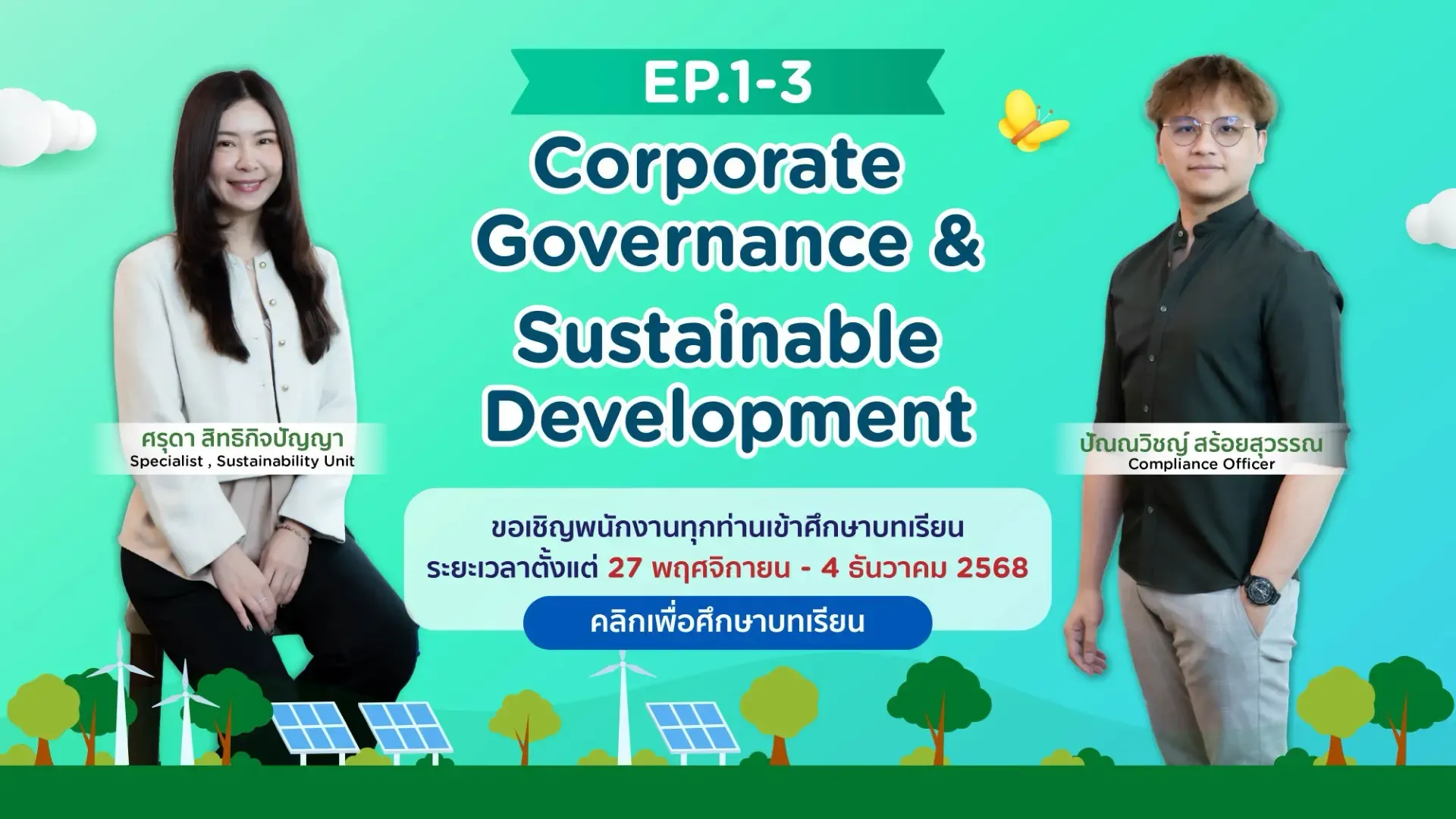
The Company has developed a training program to provide knowledge on Anti-Corruption, compliance with the Corporate Governance Policy, the Code of Conduct, whistleblowing, social and environmental considerations, Sustainability Development, and respect for human rights, with the objective of raising awareness and enhancing ethical standards among employees in alignment with the principles of good corporate governance through practical and easy-to-understand learning content that can be applied in daily operations.
In addition, the program also promotes transparent and socially responsible conduct, reduces corruption-related risks, supports sustainable business operations in line with international standards, and strengthens stakeholder confidence, with a key performance indicator that employees achieve a 100% level of knowledge and understanding upon completion of the training.
A total of 1,821 persons participated in the program
The Company has developed a training program to provide knowledge on laws relating to Anti-Money Laundering and Counter-Terrorism and Proliferation of Weapons of Mass Destruction Financing. The program is designed to cover employees at all levels, including general employees and employees subject to specific legal requirements, to ensure accurate understanding and strict compliance with applicable laws and regulations, while mitigating risks of non-compliance that may adversely affect the organization. The key performance indicators require employees who are mandated by law to attend the training to achieve a minimum passing score of 70%, and general employees who attend the training to achieve a minimum passing score of 85% in the post-training assessment.
A total of 1,836 persons participated in the program
The Company has been certified as a member of the Thai Private Sector Collective Action Against Corruption (CAC) since 2016. The CAC initiative is a private sector led effort aimed at enhancing corporate governance standards, promoting transparency, and eliminating corruption in the business sector. The certification process is subject to assessment by the CAC Committee and independent auditors, covering corruption risk assessment, policy formulation and communication, internal controls, employee training and awareness, as well as the establishment of whistleblowing channels and whistleblower protection mechanisms. In addition, the Company is subject to supervision by the Bank of Thailand in areas relating to risk management and compliance with fair treatment of customers’ requirements to strengthen confidence among all stakeholder groups.